
Matisse’s Dance and Kahlo’s Gaze
Reflections on process and purpose in art

My Concrete, Tangential Brain
As an artist (in the general sense of the term), I’m probably atypical in that I’m a concrete, rather than abstract, thinker. And as someone who aspires to producing memorable, impactful work, this concreteness is difficult for me to reconcile. Though I’ve taught others to understand figurative language in poetry and to employ it in their writing, this abstract way of thinking doesn’t spring forth naturally in me.
I can’t say I’m particularly linear though. My ADHD brain makes associations that send it off on tangents. Over time, I’ve trained it to come back around to where it started, but when I’m writing, this associative thinking means my editing process often involves a lot of cutting and moving around of sentences and paragraphs or adding of transitional phrases as a way of making my thinking more comprehensible to others.
Luminous, Dancing Figures
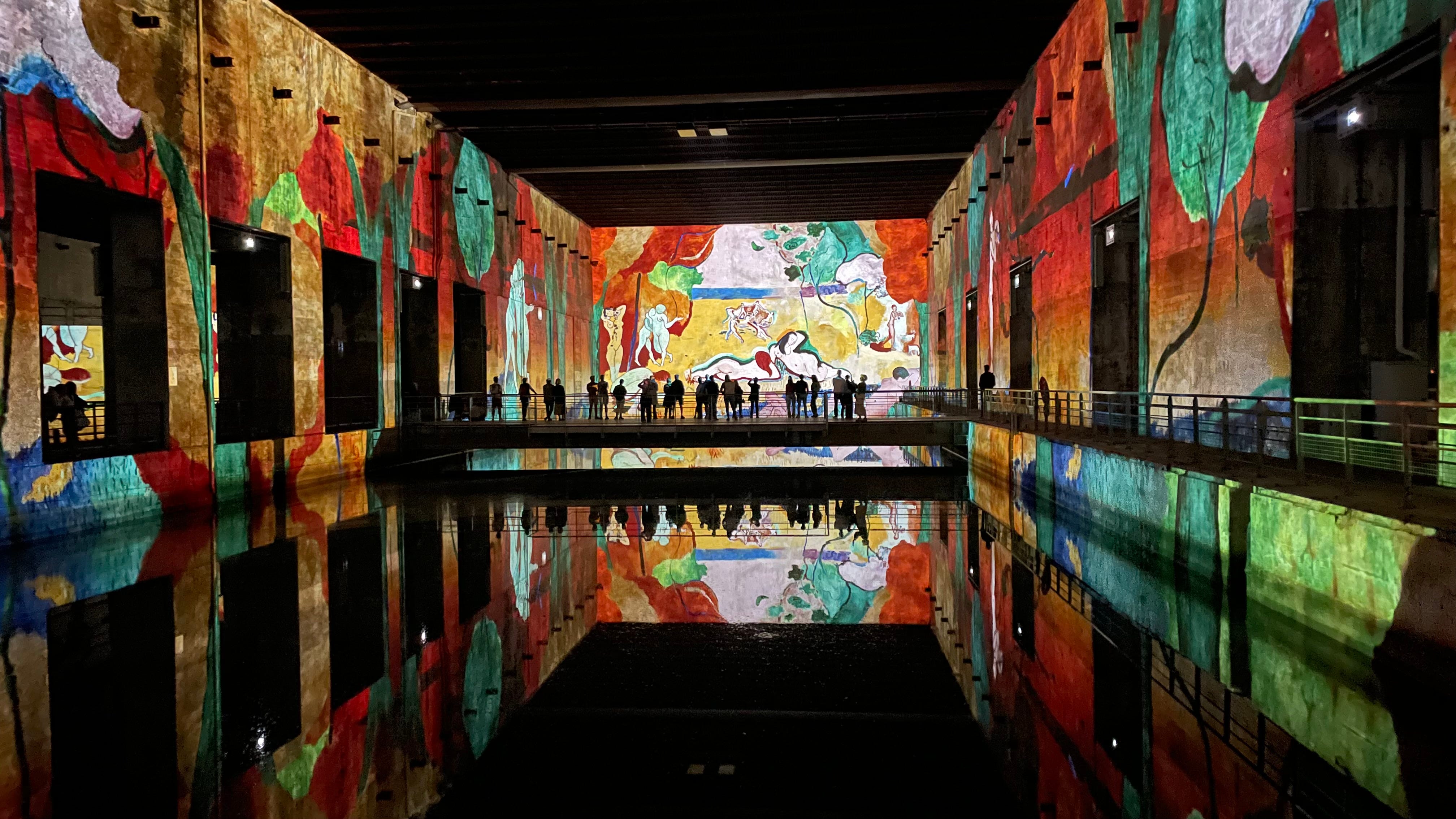
Recently, on a visit to Bordeaux, France, I found myself reflecting on the creative process at an immersive, 360 art experience called Bassins des Lumières. As I wandered the darkened, cavernous halls of a concrete WWII submarine hangar, I felt miniscule. All around me, the enormous walls were swathed in projected images of Henri Matisse’s paintings. The projections were accompanied by the artist’s voiceover commentary about his work, alternating with a soundtrack of period jazz.
At one point, Matisse described colors as if they were friends whose personalities offered a context and language for the experience of being alive, and it was clear he wasn’t just talking about his art, but how he experienced the world.
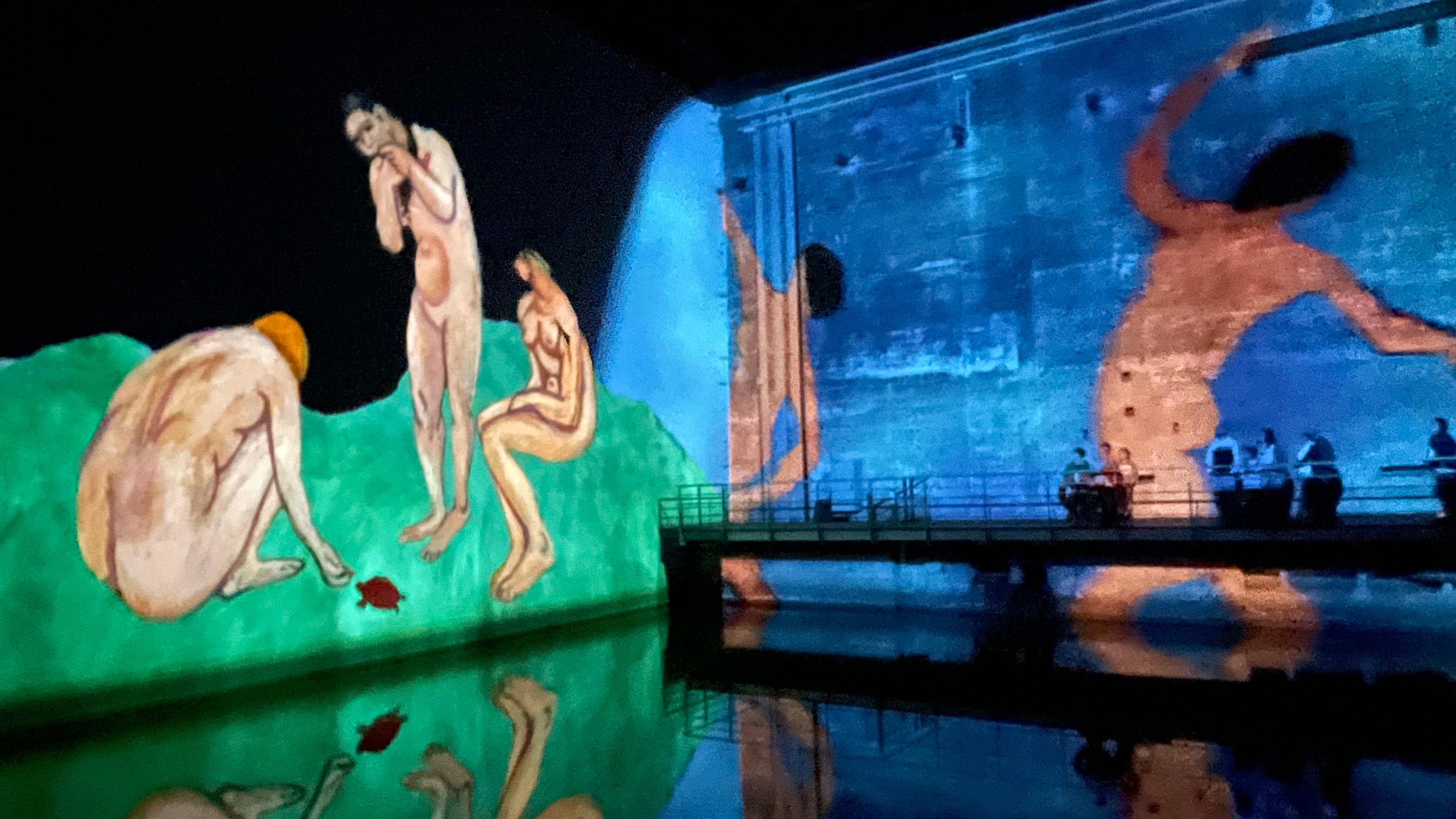
This way of viewing Matisse’s work also served to highlight the evolution of his style from more realistic depictions of the human portrait into an increasingly expressive representation of the physical form, with movement and color in conversation.
The Confrontational Gaze
The Matisse film was followed by another, about Frida Kahlo, which, unsurprisingly, was very different in feel. When I first encountered Kahlo’s self-portraits in Mexico City’s Museo de Arte Moderno in 1989, I was knocked off-kilter by their visceral power. Some of her most famous paintings depict the artist with broken spine and gaping heart, graphic depictions of the suffering she endured following a catastrophic bus crash at age 18. In the accident that came to define her life, Kahlo’s body was impaled by a metal rod, leaving her spine shattered and uterus punctured.
By this time, she had already been lamed by childhood polio, which had kept her in bed for nearly a year. Bedridden once again, this time in a body cast, Kahlo began painting. Over time, she developed a series of self-portraits that merged the surreal, symbolic, and literal.


In the years that followed, Kahlo’s suffering was compounded by her inability to carry a pregnancy to term and her tempestuous marriage to celebrated artist (and notorious philanderer) Diego Rivera, whose worldwide acclaim overshadowed hers. In the art world, Kahlo was routinely ignored or pushed aside, most notably by the surrealist artists with whose work she felt a strong kinship.
Though Matisse was born 38 years before Kahlo, the timelines of their work overlap. Both artists died in 1954—Matisse at 84 and Kahlo at 47. While the styles and thematic content of their work differed tremendously, I found their back-to-back juxtaposition in the space compelling. Where Matisse’s colorful figures stirred my inner playfulness, Kahlo’s penetrating gaze dared me to witness human suffering without looking away.
A Life Lived in Spirals
Encountering powerful works of art, especially in such an immersive environment, challenges me to consider how I can tap into more innovation and expressiveness in my own work. How might I be more figurative and intuitive as I articulate my unique vision, and most importantly, be more honest and vulnerable, as I strive to connect with others through my writing?
When I’m drafting, my narrative often jumps from one topic to the next, themes intertwining, connecting, spiraling back and forth, making a strange sort of intuitive sense to me. As I grapple with shaping these ideas into a more cohesive, linear train of thought, I recognize that life isn’t linear. We don’t live life forward, so much as we spiral through it, jumping back and forth, revisiting old themes and conflicts that rise up again and again. Sometimes, I feel as if I’m endlessly walking on one of those M.C. Escher staircases, trying in vain to find the way out.
When I try to pigeon-hole myself, I deny dialogue between the various facets that have roles to play in my personal story. And when I straighten out a circuitous narrative, I run the risk of becoming increasingly distant from my experience and thus, less honest.
I allow myself an edited linearity when it serves as a way of making sense of a life lived in spirals. Case in point, I not only repeatedly reconfigured the order of sentences composing these four paragraphs (which previously were just two); I also considered deleting them entirely. Do they even belong to this discussion? Are they too much of a tangent? I’ll leave them in and let the reader decide.
The Dynamic Between Process and Purpose
The work of these two great artists made me wonder, does process inform purpose, or the reverse? Where process is concerned, on my best writing days, my writing rushes through me, an intuitively channeling. Once the initial idea has come through, I consciously edit and shape it, endeavoring to make it make sense to myself and others.
Purpose is harder for me to pin down. What do I wish for my reader to come away with? And which readers do I aim to attract with my writing? I wonder if Matisse and Kahlo were at all concerned about these things. Today’s artists seem to me to be at least as driven by purpose as by process.
I have trouble making sense of my process because I’m too close to it, too in the moment. Perhaps the cohesiveness and sense I wish to see in my work will be available to me in retrospect, the way we can now see how Matisse moved from figurative paintings to more abstract paper cuts.
When I was in Paris a couple of weeks after Bordeaux, I learned from a film in an exhibit at the Musee d’art Moderne that Matisse originally used paper cuts as a tool. They served as placeholders in his creation of a commissioned, painted mural and were eventually removed. The cut-outs made it easier for him to reconfigure the colors and shapes of his large, outlined figures before deciding how they would be painted. Once the mural was completed—after two years of work—Matisse felt inspired to explore paper cutting as a medium, at the age of 60. As it turned out, he had another 24 years to develop this language.
So, it would seem the relationship between process and purpose is individual, dynamic, and evolving, more of a dialogue than a matter of cause and effect. My own process is a conversation between intuition and intellect, between surrender and shaping. My purpose is to engage the reader and offer opportunities for their own reflection and insights. I’d like to have a more specific, targeted purpose, but for now, I let go to the faith that if I keep surrendering to my process, that higher purpose will reveal itself in time.
I’d love to continue this exploration as a discussion. I’m wondering about my readers who are writers or artists in other mediums. How is your work informed by process and purpose? I’d love it if you left a comment on the Substack platform.
With love,
Gillian
Two requests:
My words are entirely my own. I do not use AI for any part of my writing process. Creating original content without AI shortcuts requires time and effort. If you enjoyed this post, please do me a favor and leave a heart. Your engagement helps me gauge the impact of my efforts and gives my ADHD brain much-needed dopamine hits!
If you haven’t done so already, please consider a paid subscription, which gives you access to all of my posts and helps me build a living from my writing in a time when supporting oneself as a writer has become increasingly difficult. As always, thank you for reading! I am honored by your interest.
Ways I might help you:
I offer private coaching for writers who want to author a book or step up their game, high school students applying to American colleges and universities, and artists applying for grants and residencies. To learn more, visit my website or send me an email.
Stay tuned for more info on my upcoming course, Courageous Action: Writing Our Way through Fear and Self-doubt.