
"Beeingness," Flow, and Abandoned Drafts
The importance of sitting with ourselves through our writing process

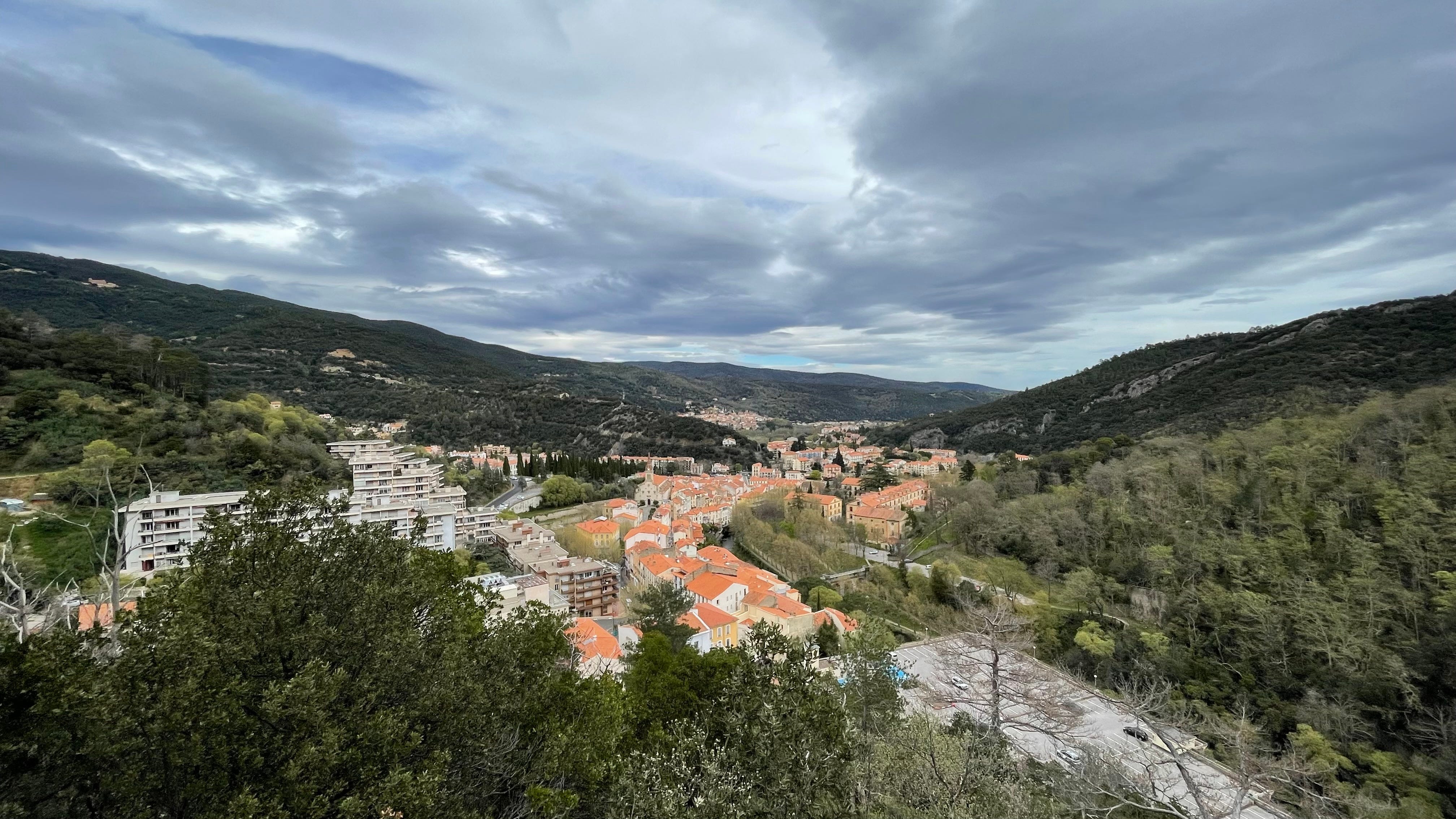
A Self-Styled Catalunyan Mountain Writing Retreat
The photo above is of a small town in the French Catalunyan Pyrenees called Amelie-les-bains-Palalda. For the past week I’ve been staying in a studio rental in one of those white modern buildings in the left of the photo, situated on a hill overlooking the town and this panoramic vista. This is more or less the view from my balcony, though the straight-on view from inside is a looming pair of craggy, forested hills. I took the photo on a hike over one of those hills. Behind me, beyond view of the town, are the snow-capped peaks of the Pyrenees.
Today is the last full day of my peaceful alpine getaway, something I desperately needed after three weeks immersed in the city energy of Madrid, Granada, and Barcelona, followed by a powerful spiritual retreat in the mountains of Girona. My purpose in coming here was to hole up, be inspired by nature, hike in said nature, write, integrate the experiences of the past month, and refocus attention on my upcoming course. I have achieved all of these goals, though given the number of them, each was modestly accomplished.
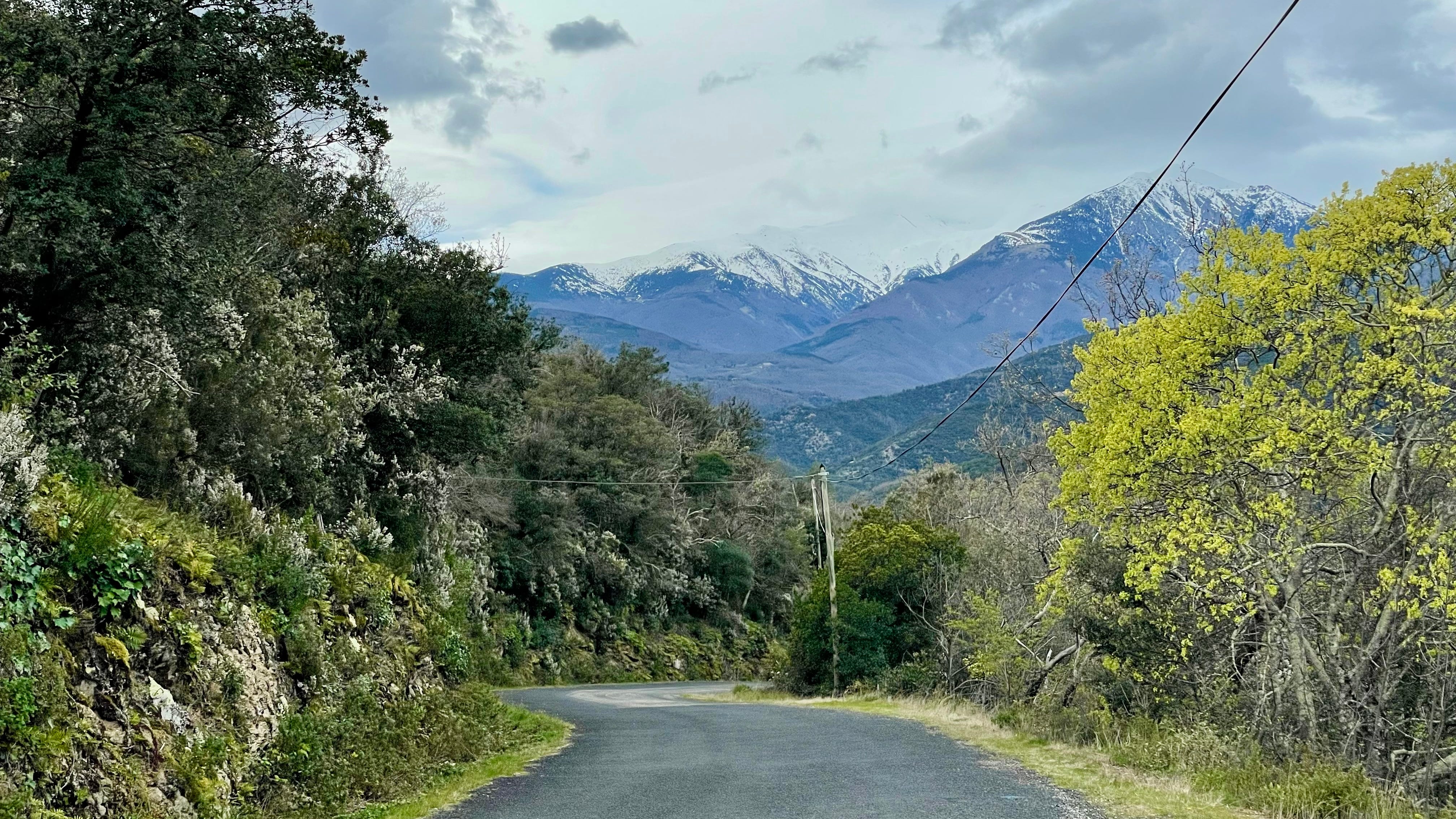
The aforementioned hidden mountain vista I only saw after I had hiked for twenty minutes up a steep, rocky, winding trail. It seems an apt metaphor for writing, as the challenges we face remain hidden until we are deep in the process, slogging uphill.
Being a Writer and Hacking the Writing Process are Not the Same
Yesterday morning, I saw a compelling Instagram post by the poet Chen Chen, about how AI undermines and even negates the act, discipline, and purposes of being a writer. I hope he won’t mind my selectively excerpting it here. I’ve used paragraph breaks to maintain his slide structure. I encourage you seek out the full post.
In addressing claims that AI is a useful, time-saving tool for writers, Chen Chen says:
it takes time to write well…the time spent learning one’s craft is everything
time is an essential ingredient for writing. you have to spend time struggling to find original language, to think in original ways…and you have to sit with yourself again and again and again
i’m not saying good writing has to take a long time…I’m saying good writing has to take *your* amount of time getting immersed in the process. getting weird. getting lost. in your own process
[AI is] built on large-scale plagiarism and it robs you of the chance to actually be creative…
i don’t want to “save time.” i want to spend it, doing this
These words resonate deeply for me in consideration of my own process. In January, as part of a visioning workshop with the London Writers’ Salon I made a commitment to show up for their Writers’ Hour and write every weekday morning, and to publish a Substack post every Friday. I felt strongly committed, but I knew it would be a tall order to stay the course. For someone with an ADHD brain, routines and deadlines are necessary for accomplishing anything, but they quickly grow tedious and need to be changed up, or there’s a danger they’ll be abandoned entirely. A single lapse can send me off into a new reality where I don’t even remember I have goals, let alone the routine I designed to fulfill them. Since making that commitment nearly three months ago, I have published on Substack exactly twice—a far cry from the dozen or even half dozen I had hoped for.
The Black Hole of “Beeingness”
When Chen Chen says that, as writers, we have to sit with ourselves “again and again and again,” he’s identifying the heart of the writer’s struggle. We face ourselves in not only what we write, but how we write. Facing ourselves requires courage and the willingness to self-reflect and grow. In short, if you’re an honest writer—and who wants to read anything written by a dishonest writer?—you can’t hide from yourself. I thought I’d take a moment to show you what it looks like for me to sit with myself through the writing process.
Usually, when I sit down to write a Substack post, I’m fired up about an idea I want to share with others. Sometimes, I’m so into it that I fall into ADHD hyper-focus mode, a black hole where I become blind to the passage of time. I can spend the whole day in one spot on the sofa tapping away on my keyboard with only the annoyance of a grumbling stomach or a full bladder to remind me of how long I’ve been at it. I’m like a bee, buzzing from one flower to another, collecting pollen. I’m not sure I’d call this state “happiness,” exactly. But when I’m in the flow of creation, it feels like my natural state, a state of pure “beeingness.”
A bit of humor about “pure being” from one of my favorite comedies. If you can’t see an embedded video here, you can click the link to watch it on YouTube.
The Rubber Tube of Resistance and the Figure in the Marble
Other times, I might feel a strong urge to share something I’ve recently experienced, but it feels as if there’s an inflated rubber tube of resistance around it. I poke it inward with some words, and it pushes right back.
Take your words and go! it seems to say. They are pitifully inadequate!
It feels burdensome to carry inside me all of the stories I haven’t yet shared. And sharing them verbally is so much easier and more instantly rewarding. I get it off my chest, and the relief is immediate. The shaping of a piece of writing takes time and devotion and requires that I push past that rubber tube of resistance and self-doubt.
Michelangelo famously said about sculpting that the figure was waiting for him inside the marble, and it was his task to remove the excess material in order to free it. Evoking an ineffable experience feels to me like that figure in the marble. In order to coax forth the form, I need to find the magic words that transport the reader into the moment and somehow convey my experience of it. I hold the experience inside me, yet freeing it feels impossible. When I’m approaching such a subject, I make an attempt, but I might abandon my figure and allow it to remain trapped. Or I save my writing attempt as a record of the experience for my journal, while letting go of the need for it to be a good piece of writing. I then either try writing on another topic or take a break from writing.
Sometimes, I write something that feels too honest and raw to share. I understand that this is a requirement of the job. If I want to write pieces that people will see themselves in, not to mention alchemize my own wounding in an effort to help others do the same, I have to roll over and expose the bare belly of private shame. I keep trying to do it, and I keep backing off. This post is a step in that direction.
Editing and Shaping is its Own Black Hole
Once I have a draft, I put it aside. The next day, I rework it. I read it through and make small tweaks to the language. Before long, I’ve read it multiple times, and I’m cutting sentences or moving them around. One recent development of my ADHD that I’ve noticed during the past year or so is that I often write my story out of order. When I return to it, I see that it would make better sense in a different order, and I wonder how my brain could have sequenced it the way it did. When I first noticed this phenomenon, I was alarmed by it, but I’ve come to embrace it as a part of my process. I let myself write my story in whatever order it comes out and rework it later.
I might put in 1-3 hours a day shaping, editing, and rewriting a piece. It’s my natural inclination to expand the story to include more detail. Then I check word count and decide it’s too long. So, I cut. I like the tangent I introduced better than the original topic, so I cut out the whole beginning and paste it into a blank document to use “another time,” (and then forget about it). Sometimes, I save the cut bits to my journal folder. In all, I can spend 10-15 hours stretched over several days on a single piece of writing.
The Dreaded Button
On publication day, the process of getting a piece of writing out of the Word doc and into the Substack letter format takes me at least a couple of hours. I’m deciding on the formatting, searching for an intriguing image that will attract people’s attention and make them want to click, adding external links, deciding how many photos to use and importing and captioning them, maybe creating a collage in Canva and importing it as a jpeg, making sure to uncheck that dreaded box in the settings that defaults to paid subscribers only, previewing how it all looks on mobile and desktop, and sending myself test emails.
The whole time, I’m rereading and editing, rereading and editing, tweaking, tweaking, tweaking, before I finally summon the chutzpah to press the terrifying “Publish” button. Taking so long with the layout might in part be a way of stalling the inevitable, helping me feel more relief than dread when I click the button.
Of course, all of this only happens when I actually decide to publish the thing I’ve been working on all week. So far this calendar year, I published posts on January 1, January 10, and February 4, so you might reasonably think I haven’t written anything since the first week of February. But you’d be wrong. It’s true that, since I left for Spain on March 2, I mostly haven’t been writing. I was busy playing tourist and birthday girl for a couple of weeks. But after that, I wrote a post about my birthday celebration. I put in the hours and process just described, and then I looked at it, cringed, considered it unpostworthy, and abandoned it in my Substack folder. There are a lot of abandoned drafts in that folder. The ADHD writer’s conundrum: If I don’t put in the hours, I’m convinced it won’t be good enough to publish. If I do put in the hours, by the end I’m probably so sick of it that I no longer want to publish it.
The Gap Between Myself and the Miraculous Ones
This is my process, for better or worse. In terms of a tangible product, it’s for the worse, I guess, insofar as it takes up a lot of time, I have little show for that time, and my eight paid subscribers—and some of the 342 free subscribers who might be thinking, “I would pay if she’d just post something now and then”— all probably think I’m not writing. And for the purposes of said subscribers, how much I’m actually writing is immaterial if you can’t read any of it.
On the upside, as Chen Chen says, all of this struggling and getting lost, getting weird, and facing myself over and over is what makes me a writer and helps me get better at my craft. If I outsourced it to AI, it would certainly be a whole lot faster and easier, but there would be none of this process to learn and grow from, no self-revelation. My process is involved and non-linear, but it’s my own. Everything I write, whether read by others or not, contributes to my writing’s evolution.
There’s an interview excerpt from journalist Ira Glass that was made into a short film called The Gap. I encourage you to watch/listen to it yourself, but to paraphrase for my purposes here: Writers become writers because we love and admire good writing. But having discerning taste makes writing hard because we inevitably have to slog through years of writing stuff that doesn’t measure up to our standards before we can write anything that meets with our own approval—what Glass refers to as “the gap.” We look at that high bar we’ve set, and then we look down at our own work and think, This is amateur crap. I can’t share this.
For me, the high bar is occupied by writers like Patti Smith, Russell Banks, Joyce Carol Oates, and Ann Patchett, whose prose and storytelling at times feel nothing short of miraculous to me. I’ve been writing for the better part of 40 years, and I don’t feel anywhere close to their level. In my opinion, this is because miraculous prose can’t be learned. Some writers are blessed with beautiful words that spill out of them. I’m not saying they don’t also sit with themselves, struggle with the structure of their novel or memoir, or spend hours editing and shaping. I only mean that the words they have to work with are exquisite to start with.
I’ve taught and attended many writing classes and groups, and I’ve seen it happen right in front of me. A prompt is given, we all write for fifteen or twenty minutes, then participants share aloud. In a group of 10-30 writers, there will be one whose spontaneous writings are sumptuous, gorgeous, miraculous. I’m being neither self-deprecating nor self-shaming when I say I’ve accepted the fact that I’m not that writer. I’m only offering what I think is a grounded, realistic assessment of my abilities. Still, I am inspired by those who do have that gift of miraculous prose, and that inspiration helps me continue to elevate my writing to an ever higher level.
Some of you have told me you enjoy my writing. As I mentioned a moment ago, eight of you have paid subscriptions despite how little I publish, ostensibly because you want to encourage me to keep at it. I’m grateful for those votes of confidence. I deeply appreciate your faith that I’ll one day finally make something more tangible of my writing. In the meantime, I hope bearing witness to my evolutionary process as a writer provides a value of its own.
Healing, Acceptance, and Progress
Now you know my process. Make of it what you will. I’ve gotten to a point in my healing where I no longer wallow in self-recrimination. I accept what is and keep trying to do a little better each time I show up to the page. And sometimes, “doing better” means setting a limit for how many hours I’m allowed to work on a piece.
So, as a measure of accountability in that regard, I’ll reveal that drafting this post took me not quite two hours. Editing and posting it took another six or seven (including YouTube rabbit holes). Under 10! Progress!
If you are a writer, I encourage you to click “comment” and take a moment to share a bit about your own process. Did reading about mine support you in offering yourself some grace? I hope so.
With love,
Gillian
Thank you for sharing this! My process is quite the same, as it takes me time and there is always a measure of inner tumult to move through with every post. I see you! ❤️
Thank you, I liked this.